I need a nap or twenty, and then about fifty-seven cups of coffee. I'm just not used to being set free to dork out completely without the constraints imposed by, you know, motherhood. And...
Continue reading
0 Comments
Palm Springs was amazing. I wandered the desert and climbed mountains and ate sushi and lounged in spas and met the Lord of the Cellos and fell in love with a three-legged dog…
I received the following message via Facebook today. I think that it’s pretty awesome. And by awesome, I mean, so profoundly insulting and ignorant that I actually yelled out “REALLY???” and scared some flamingos.
I suppose that the following conversation with Emilia was inevitable. I just didn’t expect to have it when she was four.
Emilia, having spilled some juice down her shirt: “oh, f***.”
Me: “Emilia Elizabeth Ann! What did you just say?”
Emilia: “I said, oh f***.”
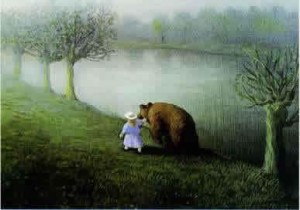 My mother was and still is an inveterate teller of tall tales, especially in conversation with children. She delights in the wide-eyed fascination of children with all things fantastic, and decided very early in her career as a mother that it was part of her job to keep the eyes of her own children and those of any children who accidentally wandered into range of hearing as wide as possible.
Accordingly, I grew up in a home in which it seemed entirely possible that there were sea creatures living in the plumbing and gnomes hiding in the closets. There were fairies and elves and imps and other magical creatures in the woods behind our house, and they lived in harmony with the animals there – the squirrels and birds that I saw every day, and the raccoons and skunks that I saw less often but knew well from the tracks in our backyard, tracks that my mother was very careful to point out and explain as evidence of the late-night forest creature moondances that occurred a few times each month. I knew that the forest creatures maintained harmony in their community through the frequent town-hall meetings that they held in a mossy stump – I knew this because my mother showed me exactly where they all sat during these meetings and held up various broken twigs and branches (used as benches) as evidence. I knew that I should never, ever pick toadstools, because if I did so I would be destroying the shelter of the littlest creatures of the forest.
I also knew that my sister and I came from a cabbage patch, and that if we unscrewed our bellybuttons, our bums would fall off. When I got old enough to start doubting these tales, I would confront my mother upon each telling: are you telling me a story?
Of course I am, my darling, she’d reply. But that doesn’t mean that I’m not telling you the truth.
This – the post below – is something that I wrote a few years ago, when I was still in the first joyous and anxious flush of new motherhood. It’s one of my very favourite posts, although one that has gotten buried in the sands of WordPress, and time. It’s also a post that I’ve been thinking about a lot, not least because of my sister’s ongoing struggle with the prospect of saying goodbye to her son (a struggle that extends to all of us), but also because of my father’s passing, and my keen awareness, in the long process of letting him go, of how difficult he found it to let me and my sister (and, in a completely different context, my mother) go, of how difficult he found it to let anything go. And then, last night, I saw a film (about which I will write more at length, once I can do so without crying) that touched all these nerves, and more, and reminded me that what I thought was a unique experience of motherhood is, in fact, an experience of parenthood, one that fathers share no less for being fathers. And that, perhaps, it is an experience of love generally – of the necessity of giving love air to breathe, of the inextricability of loss from love, of the impossibility of holding on to those we love too tightly – of the undesirability of holding on too tightly – of the inevitability of goodbye. So I am revisiting it here. I am not sure, yet, what I have learned from revisiting it. Other than, maybe, that I need to meditate more upon the cruelty and beauty and necessity of letting go.
*****
One of the most difficult things about pregnancy, for me, was that it forced me to confront myself as a biological creature. It forced me to experience myself as a body, as a being put entirely into the service of nature. My every wakeful – and not so wakeful – moment was spent in a state of hyper-consciousness about my physicality: I was nurturing a life, and that life depended upon my physical being, and no force of intellect or imagination could alter or facilitate or intercede in that dependency. And as a person who had spent all of her conscious years in her head – and someone who was well-trained in a school of philosophical thought that emphasizes the absolute primacy of mind over body, reason over appetite and base sense – this was very, very hard for me.
So I was anxious – anxious beyond measure – about birth and new motherhood, which I perceived as a broadening and deepening of this experience. I didn’t fear it, exactly: I wanted the experience. Every fibre of my physical being strained toward this experience, and demanded that my mind follow – this, in itself, was disconcerting. The thing of it was, rather, that I doubted my ability to stay the course: how would I ever, ever find my way through this dense thicket, this overwhelming jungle, without maps, without books, without the compass of my intellect? How would I survive, if I had only the thrum of my senses to guide me?